Custom Ecommerce Store Cost vs Shopify: The Real 3-Year Math
Shopify looks cheap at $39/month until you add apps, transaction fees, and three years of subscriptions. Here's the real total cost of ownership vs a one-time custom store you own.

Key Takeaway
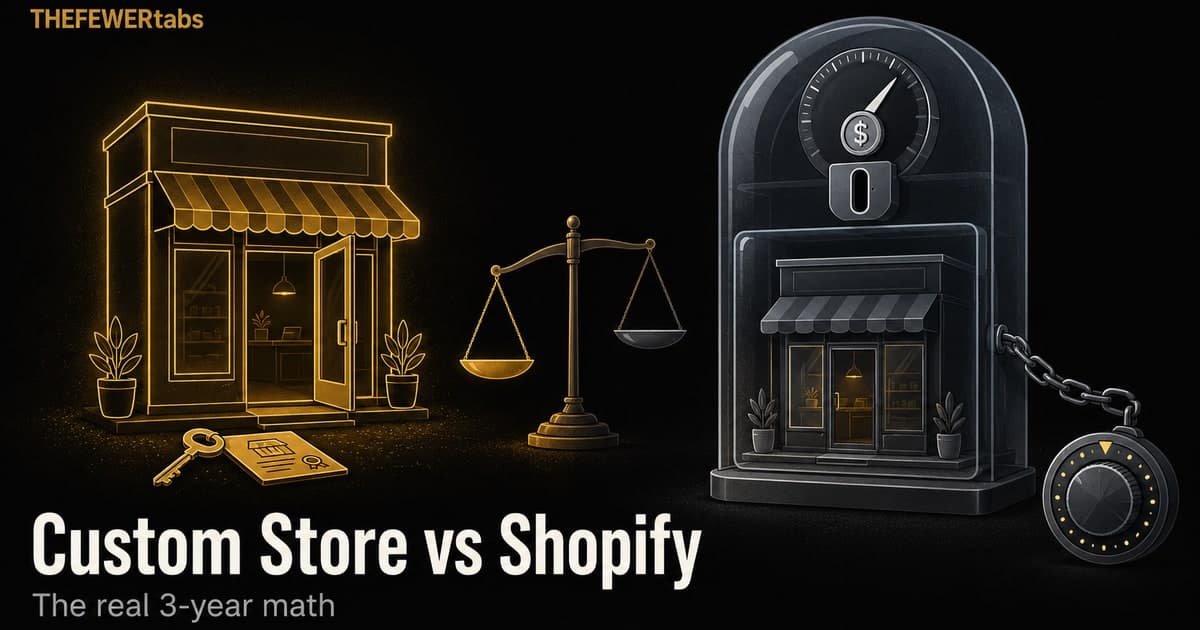
Shopify's $39/month looks cheap until you add apps, transaction surcharges, and three years of subscriptions. The real comparison isn't “build cost vs. monthly fee” — it's total cost of ownership. Over 3 years, renting a platform often costs more than owning a store outright.
The trap of comparing build cost to a monthly fee
The most common mistake sellers make is comparing a one-time build cost to a single month of Shopify. “$1,799 vs. $39? Shopify wins.” That math is wrong because it ignores time. Shopify charges $39 every month, forever. A custom build is paid once and owned forever. The honest comparison is total cost over the years you actually run the business.
What Shopify actually costs over 3 years
Let's add up a realistic Shopify Basic store over 36 months. (Rates shift — treat these as directional, then confirm current pricing on Shopify's site.)
- Base subscription: $39/month × 36 = $1,404
- Paid apps (reviews, email, upsells, SEO — say $40/month blended): $40 × 36 = $1,440
- Theme (one-time, premium): $350
- Payment-processing surcharge (if not on Shopify Payments): variable, often hundreds/year
Conservative 3-year total: $3,194+in subscriptions and apps alone — and you still don't own the store. Stop paying and it goes dark.
See the math for your own store
Get a free audit and I'll lay out your 3-year cost on Shopify vs. a one-time custom build you own.
Get My Free Audit →What a custom store actually costs
With SwitchKit, the cost structure is fundamentally different:
- One-time build: $1,799
- Monthly platform fee from us: $0 (pass-through hosting ~$0–$45/mo)
- App subscriptions: $0 (features are built in, owned by you)
- Ongoing hosting: a flat, low cost you control (not a percentage of your revenue)
- Payment processing: ~2.9% + $0.30 (standard Stripe/PayPal)
Over 3 years your total platform cost is roughly the one-time build plus cheap hosting — no compounding subscription, no app-store nickel-and-diming. And every dollar of that builds an asset you own, not a rental you forfeit if you stop paying.
The ownership difference
The cost gap is only half the story. The other half is what you actually control:
- Shopify: you rent the platform. You own your products and customer data, but not the code, the checkout, or the hosting. Your store lives only as long as you pay.
- Custom store: you own the source code, the database, the checkout, and the hosting. You can hire any developer to extend it. If you stop paying anyone, the store keeps running.
Renting makes sense when you're testing. Owning makes sense when you're committed to the channel.
When each one wins
Choose Shopify if:
- You're validating a new idea and want minimal up-front cost
- You don't want to think about hosting or code
- You're fine renting the platform indefinitely
Choose a custom store if:
- You're committed to this channel for years
- You want to stop paying a monthly subscription forever
- You want to own the code, checkout, and customer relationship outright
- You're a marketplace seller building a second owned channel
SwitchKit: own the store, stop the subscription
SwitchKit is the “own it” option — a custom storefront built from scratch, paid once, owned forever.
- Custom storefront in 14 days — no templates, no Shopify
- $1,799 one-time, no monthly platform fee from us (pass-through hosting ~$0–$45/mo)
- Stripe/PayPal checkout + customer and order database
- Email capture, reviews, and SEO built in — no app subscriptions
- Full source-code ownership — it's yours to keep and extend
Stop renting your store
Book a free call and I'll show you the 3-year math for your situation and what owning the store looks like instead.
Book My Free Call →Before you decide: a quick checklist
- Add up 36 months of Shopify subscription + the apps you'd actually need
- Decide whether you're testing or committed to the channel
- Ask whether you need to own the code and checkout long-term
- Compare the 3-year total, not the first month
- Reserve your brand domain either way
The cheapest store isn't the one with the lowest monthly fee. It's the one you stop paying for and still own.